From October 15 to 17, 2021, the "National Forum on Applied Semiotics and Multimodal Research" hosted by the Semiotics Professional Committee of the Chinese Logic Society, organized by the School of Foreign Studiesof Tongji University and the Institute of Linguistics and Multimodal Semiotics of Tongji University, was held online. Nearly 400 experts, scholars, and students from the field of semiotics and multimodal research from across the country participated in this forum.
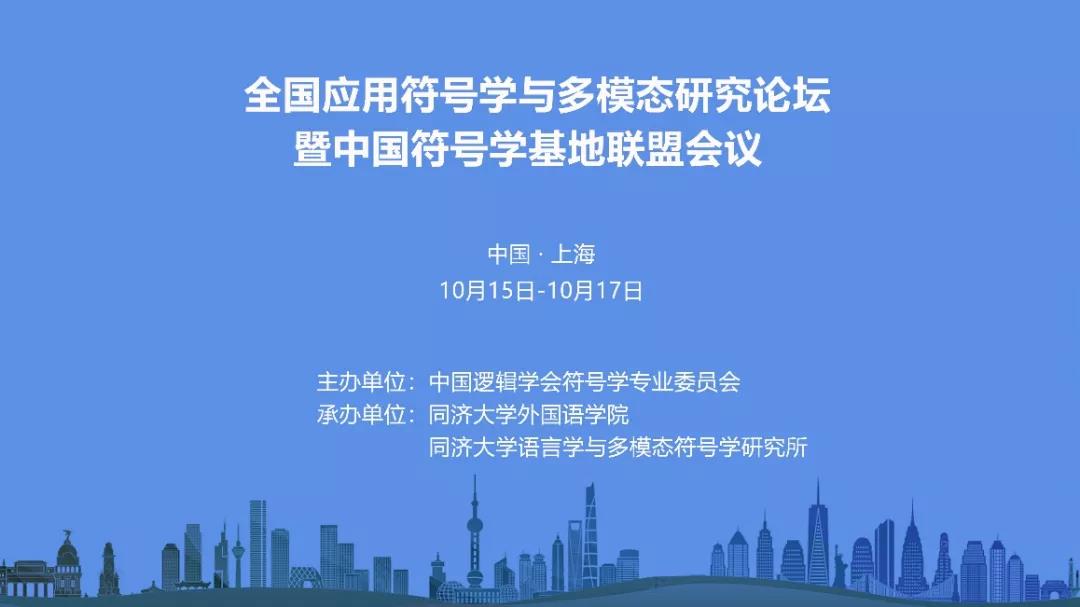
This forum focused on topics such as applied semiotics and multimodal research, advocating for interdisciplinary integration and targeting the frontiers of world research. At the opening ceremony, Professor Lou Yongqi, Vice President of Tongji University, delivered a welcome speech on behalf of the university, pointing out that semiotics and multimodal research span multiple fields including humanities and social sciences, natural sciences, and engineering and technology, with distinct interdisciplinary attributes, and are frontier topics in international research. This forum helps promote the construction and development of foreign language and literature disciplines and advances semiotics and multimodal related research domestically and internationally.
Professor Hu Zhuanglin, honorary president of the Chinese Language and Semiotics Research Association and senior professor at Peking University, attended the opening ceremony of the forum and delivered a speech. Professor Hu Zhuanglin attended the International Discourse Analysis Seminar and the 12th National Discourse Analysis Seminar at Tongji University in 2010, and was invited to attend the 13th National Language and Semiotics Seminar at Tongji University in 2018. Professor Hu Zhuanglin has led the research on semiotics and multimodal studies nationwide and has given care and guidance to the development of foreign language and literature at Tongji University.
Professor Wu Yun, dean of the School of Foreign Studies at Tongji University, delivered a speech on behalf of the school. She pointed out that promoting applied semiotics and multimodal research is an effective path for linguistic heritage, integrated innovation, and continuous development. It is hoped that the convening of this forum will provide an opportunity to enhance understanding with sister institutions, engage in active exchange, and vigorously carry out problem-oriented and interdisciplinary-based applied semiotics and multimodal research, exploring the complex linguistic phenomena in socio-cultural life and assisting the development of Chinese linguistics and the construction of new humanities.
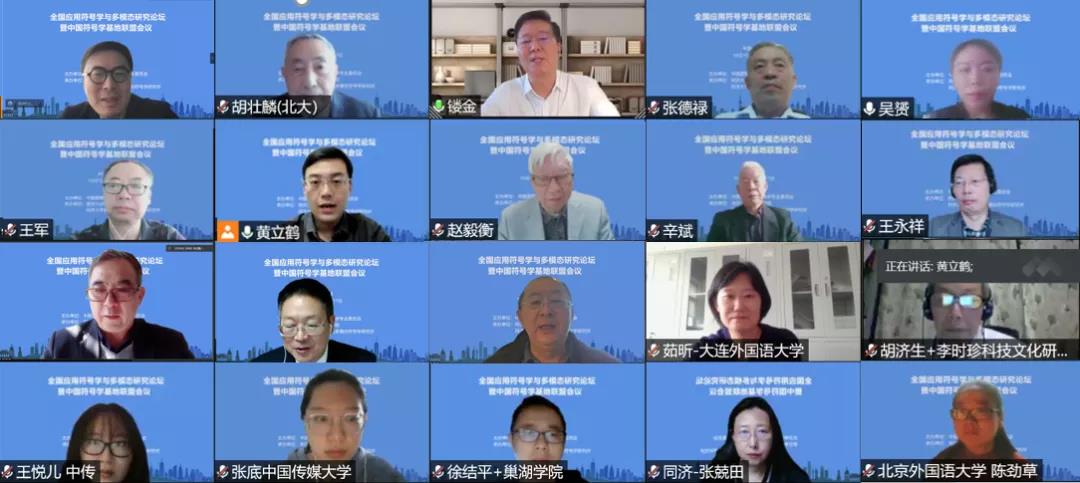
This forum invited twelve scholars to deliver keynote speeches. More than a hundred participants directly participated in discussions in eight parallel sub-forums.
On the morning of October 16, the first keynote speech session was hosted by Professor Wang Jun from the School of Foreign Languages at Soochow University. Professor Zhao Yiheng from the School of Literature and Journalism at Sichuan University, Professor Zhang Delu from the School of ForeignStudiesat Tongji University, and Professor Wu Yun, dean of the School of ForeignStudiesat Tongji University, delivered keynote speeches in sequence.
Professor Zhao Yiheng's keynote speech titled "The Definition of Art: The Starting Point of Aesthetics" deeply explored the definition of aesthetics, proposing that the definition of art should proceed from semiotic aesthetics, returning to functionalism from the perspective of the unique meaning value of art, and suggesting that the "transcendence theory" of art found in pragmatics should be the foundation for the definition of art, viewing artistry as "the quality that elevates the recipient from the mundane to the transcendent through form."
Professor Zhang Delu's keynote speech focused on the topic "Applied Semiotics: Theory, Nature, and Research Scope," exploring the current research status of applied semiotics, the connection between social semiotics, disciplinary semiotics, and multimodal discourse analysis to general semiotics and applied semiotics, the definition and research scope of applied semiotics, and the implementation framework for applied semiotics to solve related problems through interdisciplinary semiotic integration and complete communicative tasks.
Professor Wu Yun's keynote speech was titled "Multimodal National Translation Strategy Research on Telling China's Story," discussing the importance of multimodal research for translation studies and national image dissemination from five aspects: national translation under the mission of "telling China's story well," the connection between national translation and China's story, the importance of "re-narrating" China's story through multimodal translation, the definition and connotation of multimodal translation, and the multimodal translation path for telling China's story.
The second keynote speech session on morning was hosted by Professor Zhang Delu. Professor Wang Jun from the School of Foreign Languages at Soochow University, Professor Xin Bin from the School of Foreign Languages at Nanjing Normal University, and Professor Wang Yongxiang from the School of Foreign Languages at Nanjing Normal University delivered keynote speeches in sequence.
Professor Wang Jun's speech titled "Empty Sign Analysis of 'Waiting for Godot'" systematically sorted out and analyzed various empty signs produced by the protagonists of the absurdist drama "Waiting for Godot" based on two basic categories of empty signs (signifier being empty and signified being empty), revealing the charm of artistic works from a new perspective of empty semiotics.
Professor Xin Bin's keynote speech titled "Multimodal Critical Discourse Analysis" first explored the "multimodal turn" in critical discourse research, then took the movie poster "My People, My Country" as an example to conduct a detailed analysis of the grammar of the poster as an image mode, demonstrating the application value of multimodal critical discourse analysis in the field of film and television works.
Professor Wang Yongxiang's speech titled "Semiotics and Language Education" discussed the influence of Saussure's linguistic semiotics and Peirce's logical semiotics on the development of modern semiotics, and further explained the significant impact of semiotics as a methodology on pedagogy.
The afternoon sub-forums had eight parallel sessions, with group discussions and reviews. The research topics reported in the sub-forums were very extensive, fully reflecting interdisciplinary integration, mainly involving applied semiotics research in various fields, theoretical semiotics research, semiotics and multimodal research, multimodal research and language literature, multimodal research and education, etc.; the research objects were rich and colorful, including new media videos, promotional films, movies, music, picture books, online literature, multimodal classrooms, etc., which could be described as "a hundred flowers blooming and a hundred schools of thought contending."
On the morning of October 17, six experts and scholars delivered keynote speeches. The first keynote session was hosted by Professor Cao Jin from the School of Foreign Languages at Northwest Normal University. Professor Wang Mingyu, President of the Semiotics Professional Committee of the Chinese Logic Society from Tianjin Foreign Studies University, Professor Tian Hailong from Tianjin Foreign Studies University, and Professor Tang Xiaolin from the School of Literature and Journalism at Sichuan University delivered keynote speeches in sequence.
Professor Wang Mingyu delivered a speech titled "Multimodal Expression of Semiotic Embodiment". Taking multimodality of signs as the entry point and the picture book "The Gruffalo" as an example, he elaborated on the picture book from the paths of semiotic embodiment, namely code embodiment, metaphorical embodiment, symbolization embodiment, inter-semiotic embodiment, and domain embodiment. This expanded the research scope of embodied semiotics and further demonstrated the applicability of the semiotic embodiment view.
Professor Tian Hailong delivered a keynote speech titled "Two Aspects of Semiotic Innovation", explaining the characteristics of the innovative development of semiotics from two aspects. He pointed out that one development of semiotics is shifting from focusing on the meaning of signs to focusing on the intentions of sign users, and the other is conducting in-depth exploration of Peirce's mechanism of "interpreters" interpreting sign relationships.
Professor Tang Xiaolin gave a speech titled "The Issue of Meaning in Eco's Semiotic Theory", further reflecting on Eco's exploration of "meaning" as the core issue of semiotic theory over half a century. He proposed that semiotics is the study of meaning, and what semioticians deal with are all issues of meaning. He explained Eco's special contribution to semiotic theory and further explored the characteristics of the "meaning" of semiotics.
The second keynote session was hosted by Professor Tian Hailong. Professor Luo Jian from the School of Foreign Languages at Anhui Normal University, Professor Cao Jin from the School of Foreign Languages at Northwest Normal University, and Associate Professor Huang Lihe from the School of Foreign Languages at Tongji University delivered keynote speeches in sequence.
Professor Luo Jian gave a speech titled "A Multisemiotic Perspective on Referential and Representational Signification". Based on the theoretical framework of multisemiotics and taking the novel "Anna Karenina" as an example, he compared referential meaning and representational meaning, exploring the differences between them.
Professor Cao Jin's speech was titled "Research on Multimodal International Communication of Hexi Corridor Culture in the AI Era". Integrating multimodal semiotics, translation studies, and communication theory, he constructed a theory of multimodal international communication of culture. Based on the cultural landscape of Gansu, Professor Cao explored the new ideas, new ideals, and new means provided by AI technology for the international communication of Hexi Corridor culture, which has enlightening significance for telling China's stories and spreading Chinese culture well.
Associate Professor Huang Lihe gave a speech titled "Research on Elderly Image Symbols under the Multimodal Paradigm: The Connection between Identity Construction and Psychological Appeals". Through two multimodal empirical studies of CCTV Spring Festival Gala skits and elderly product advertisements, he explored issues such as the construction mechanism of elderly image symbols, elderly self-cognition and identity construction, and discourse empowerment. He examined the laws and mechanisms for realizing the unity of social cognition of elderly images and persuasive rhetoric of elderly groups through multimodal symbols in an aging society.
At the closing ceremony, Professor Zhang Delu delivered a summary speech for this forum. Professor Zhang pointed out that this forum focused on exploring how to apply semiotic theory to different disciplines to solve practical problems. The keynote speeches at the conference mostly involved applied research of semiotic theory in multiple fields, including the application of semiotics to art, literature, and aesthetics research, the application of semiotics to translation research, the application of semiotics to education and teaching research, the application of semiotics to artificial intelligence research, and the application of semiotics to pathological linguistics research. In addition, it included theoretical research on applied semiotics, research on the innovative development of semiotics, and research on Eco's semiotic meaning issues; the sub-forum topics of the conference were diverse, fully demonstrating the application-oriented characteristics of semiotics. This conference played an important role in the development of semiotics, especially applied semiotics, in China.
Finally, the Chinese Language and Semiotics Research Association and the School of Foreign Languages at Tongji University once again expressed their sincere gratitude to the participating experts and scholars, and the forum was a complete success.





 中
中